Free parking app for Europe: Easy Find Parking for iPhone
Easy Find Parking is a free iPhone and iPad app that maps free street parking kerb by kerb in Berlin, Madrid, Barcelona, València and Kraków, plus car parks.
Easy Find Parking is an iPhone and iPad app for drivers that shows where you can park for free in European cities, kerb by kerb rather than car park by car park. It has street-level detail for Berlin, Madrid, Barcelona, València (Valencia) and Kraków, plus car parks with prices and height limits in Germany, Switzerland, the Netherlands and France, with live space counts where the operator publishes them. It needs iOS 17 or later and is free to download on the App Store.
I build it on my own, and in September 2026 rebuilt it around the cities' own open data.
Why is free street parking hard to find in a European city?
Paid zones and charging hours change street by street, are marked by signs you only see once you're there, and work differently in every city: Madrid has its SER zone, Barcelona its blue and green areas. Many councils publish all of it as open data, but as map files, not as an answer to "can I leave the car here". Easy Find Parking reads those files and draws the answer on the kerb.
How does Easy Find Parking work?
- Open the map. It centres on you, or on Barcelona if you refuse location; then pan to where you're going.
- Zoomed out, read the circles. Green circles count free parking by area, so you can pick a neighbourhood before setting off.
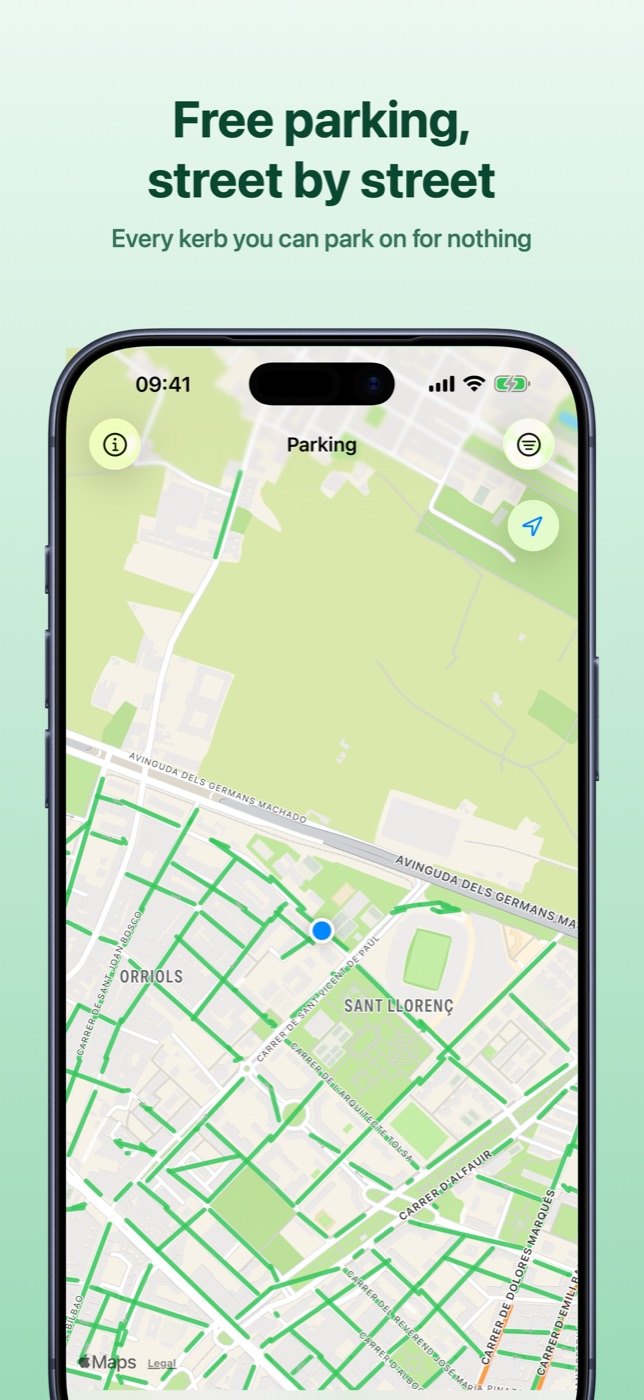
- Zoom in to street level. Each kerb becomes a line: solid green is free, dashed teal is likely free, orange is charged right now. A kerb that charges only during posted hours turns green outside them.
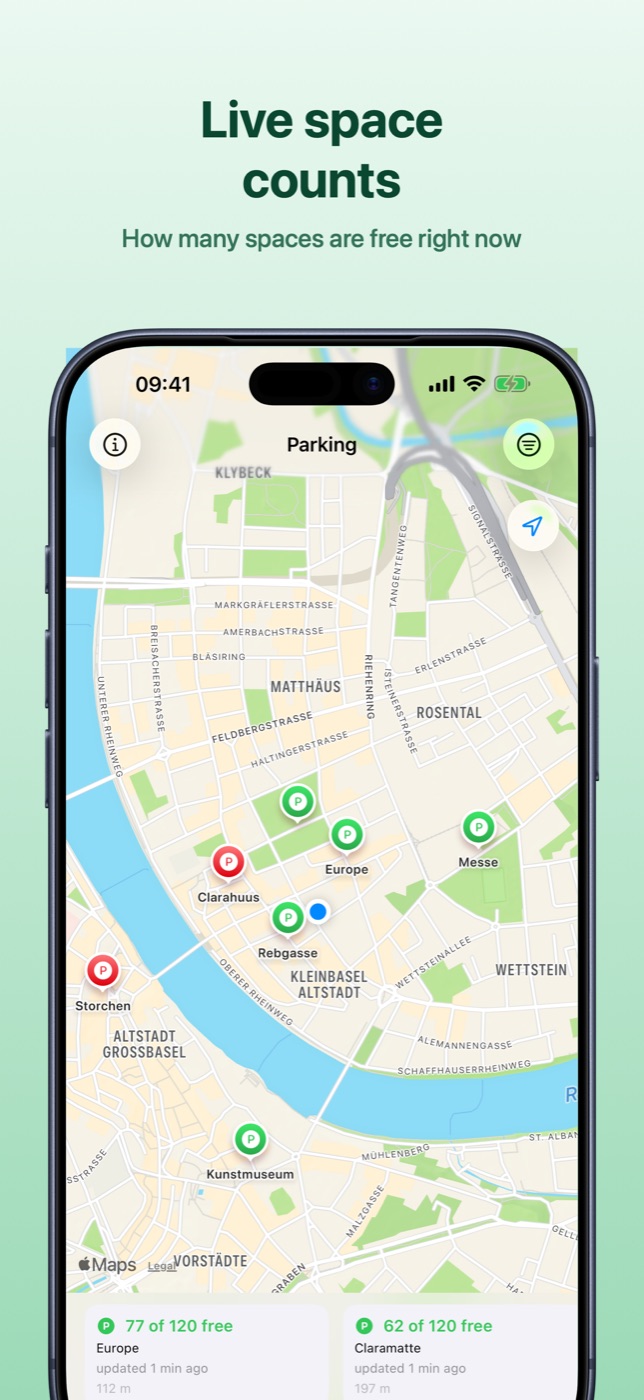
- Tap a car park pin for price, capacity, height limit, opening hours and live count, whichever the source publishes, and where each fact came from.
- Tap Directions and the route opens in Apple Maps.
Filters show free parking only, counted car parks only, or a search radius from 250 m to 5 km.
Where does the parking data come from?
From open data and OpenStreetMap:
- València publishes its free spaces outright, about 281,000 of them.
- Madrid publishes 87,000 kerb bands. The 331,000 spaces outside its paid SER zone show as likely free, because Madrid says "outside the regulated zone", not "free".
- Barcelona and Kraków publish only what they charge for, so the rest of the city is likely free.
- Berlin is mapped street by street by OpenStreetMap volunteers.
- Car parks in Germany and Switzerland come through ParkAPI, an open-source project I run my own copy of; Dutch ones from the RDW's national register, French ones from transport.data.gouv.fr.
Why only five cities at kerb level? When I measured, 99.9% of Berlin's drivable streets carried parking tags in OpenStreetMap, against 10% in Paris, 4% in Barcelona and under 1% in Lisbon. Elsewhere the street layer has to come from the city itself, and a city that publishes nothing usable gets no layer.
What's the difference between "free" and "likely free"?
A parking app that overstates free parking hands you a fine, so the two never share a label. Free means a council publishes it as free, or a street sign says so. Likely free means the kerb is outside every zone the council charges for, but no sign confirms it; the app says so in words and draws the line dashed.
The guessing is cautious. In Barcelona, a street with any paid segment within 25 m is left out, and so are main roads. Charging hours that can't be read count as charged: being wrong that way costs a walk, the other way a fine. Where there's no data, the map says so instead of looking empty.
How fresh are the live space counts?
Each count shows when it was last updated, and one older than 15 minutes turns grey as "free when last seen". Only car parks whose city or operator publishes occupancy have counts: today, several dozen in Germany and Switzerland, most in Karlsruhe and Basel. One French operator's feed reported every car park as empty, so its counts are switched off. The kerb layers describe rules, which change slowly, not whether a space is empty right now.
What happens to my location?
There's no account. Location is used only while the app is open, to centre the map and measure walking distance; refuse it and you pan by hand. To fetch parking, the app sends the coordinates of the area on screen and your filters to my server, with no account or device identifier attached. There are no ads, analytics or third-party SDKs. The map is Apple's MapKit, and Directions hands the destination to Apple Maps.
Who is it for, and who isn't it for?
It's for drivers in Berlin, Madrid, Barcelona, València or Kraków who would rather not pay for a garage, and for road trips where a car park's price and height limit matter before you turn in.
It isn't for you if:
- You're going somewhere else. Outside those five cities there's no kerb layer. Paris has car parks but not streets; Lisbon, Rome, Warsaw and the UK aren't covered.
- You need to know a kerb has a gap right now. Lines show rules, not cars.
- You want to pay for or book parking. It does neither.
- You need offline use or address search. It needs a connection, and there's no search box yet: you pan the map.
- You're on Android. It's iPhone and iPad only, in English.
It doesn't replace the sign either. A market day or roadworks won't be in any dataset.
How to get started
- Install Easy Find Parking from the App Store on an iPhone or iPad with iOS 17 or later.
- Allow location while using the app, or pan to your city.
- Zoomed out, find the area with the most free parking, then zoom in.
- Tap a car park pin for details, then Directions to drive there.
Easy Find Parking is an independent app, not affiliated with the cities, operators or projects whose data it uses; the info button on the map lists them all.
How it's built, for developers: Mapping free street parking from open data with PostGIS and MapKit.
How it compares with ElParking, Telpark, EasyPark, SMOU and Parclick: Free parking in Madrid, Barcelona and Valencia: 7 apps compared.
FAQ
How can I find free street parking in a European city?
Find out where the city's paid parking zones are: outside them, street parking is often free, though only the signs say for sure. Many cities publish their zones as open data. Easy Find Parking, a free iPhone and iPad app, turns that data into a kerb-by-kerb map for Berlin, Madrid, Barcelona, València and Kraków.
Is there an app that shows free parking in Madrid, Barcelona or Valencia?
Yes. Easy Find Parking maps free kerbs in Madrid, Barcelona and Valencia, as well as Berlin and Kraków. Valencia publishes its free spaces directly; in Madrid and Barcelona they're worked out from what lies outside the paid zones and labelled "likely free".
What does "likely free" mean in Easy Find Parking?
The kerb lies outside every zone the council charges for, but no sign confirms it is free. Easy Find Parking draws these kerbs as dashed teal lines, apart from the solid green kerbs a council or a street sign confirms.
Does Easy Find Parking show how many spaces are free right now?
For car parks whose city or operator publishes occupancy, yes: a count such as "77 of 120 free", with its age. A count older than 15 minutes is shown as "free when last seen". Kerbs show where parking is free, not whether a space is empty.
Can I find park and ride (P+R) with Easy Find Parking?
Partly. In the Netherlands it shows P+R and carpool sites from the national parking register, usually with P+R in the name, and some P+R car parks in south-west Germany report live counts. There's no separate P+R filter.
Is Easy Find Parking free?
Yes. Easy Find Parking is free to download from the App Store, and version 2.2 has no subscription, in-app purchases or ads.
Does Easy Find Parking track my location?
It has no account and no analytics or advertising code. To load parking, it sends the coordinates of the map area on screen to its own server, with no account or device identifier attached, and uses your location only while the app is open.
Does Easy Find Parking work on Android?
No. Easy Find Parking is an iPhone and iPad app that needs iOS 17 or later.
More writing
Aquarium water test log apps for iPhone: 8 compared
Eight iPhone apps for logging aquarium water tests compared: freshwater or reef, test strip scanning, species database, account, and what each costs.
Free parking in Madrid, Barcelona and Valencia: 7 apps compared
Most Spanish parking apps help you pay, not park free. Seven apps compared for Madrid, Barcelona and Valencia, and which one maps free street parking.
Pet health record apps for iPhone: 7 compared
Seven iPhone apps for your pet's vaccinations, vet visits and documents compared: which work without your vet joining, store your own scans, and cost.