A quit weed app with a day-by-day withdrawal timeline
Reset is an iPhone app for quitting weed or taking a tolerance break: a day-by-day withdrawal timeline, milestones and money saved, with no sign-up.
If you want an app to help you quit weed or take a tolerance break, this is the one I built: Reset: Quit Weed & T-Break, for iPhone, with a two-week free trial. It counts the time since you last used, shows a day-by-day cannabis withdrawal timeline for sleep, dreams, appetite, mood, anxiety and cravings, and tracks milestones and money not spent. You don't need to sign up or give an email, and your data is never sold.
What the first weeks without cannabis are usually like
Not everyone who stops gets withdrawal. A 2020 meta-analysis of 47 studies put it at about 47% of people with regular or dependent use, and higher with daily use (Bahji et al., JAMA Network Open). When it happens, the pattern is consistent:
- Start: typically 24 to 48 hours after the last use (Connor et al., Addiction, 2022).
- Peak: most symptoms peak between days 2 and 6 (same review).
- Length: usually up to about three weeks (Bonnet and Preuss, 2017). In heavy users some symptoms last three weeks or more, and sleep problems may continue for several weeks or longer (Connor et al.).
- Symptoms: most often anxiety, irritability, anger, disturbed sleep and dreams, low mood and loss of appetite. NIDA also lists restlessness, headaches, sweating, abdominal pain and tremor.
How Reset tracks a quit or a T-break
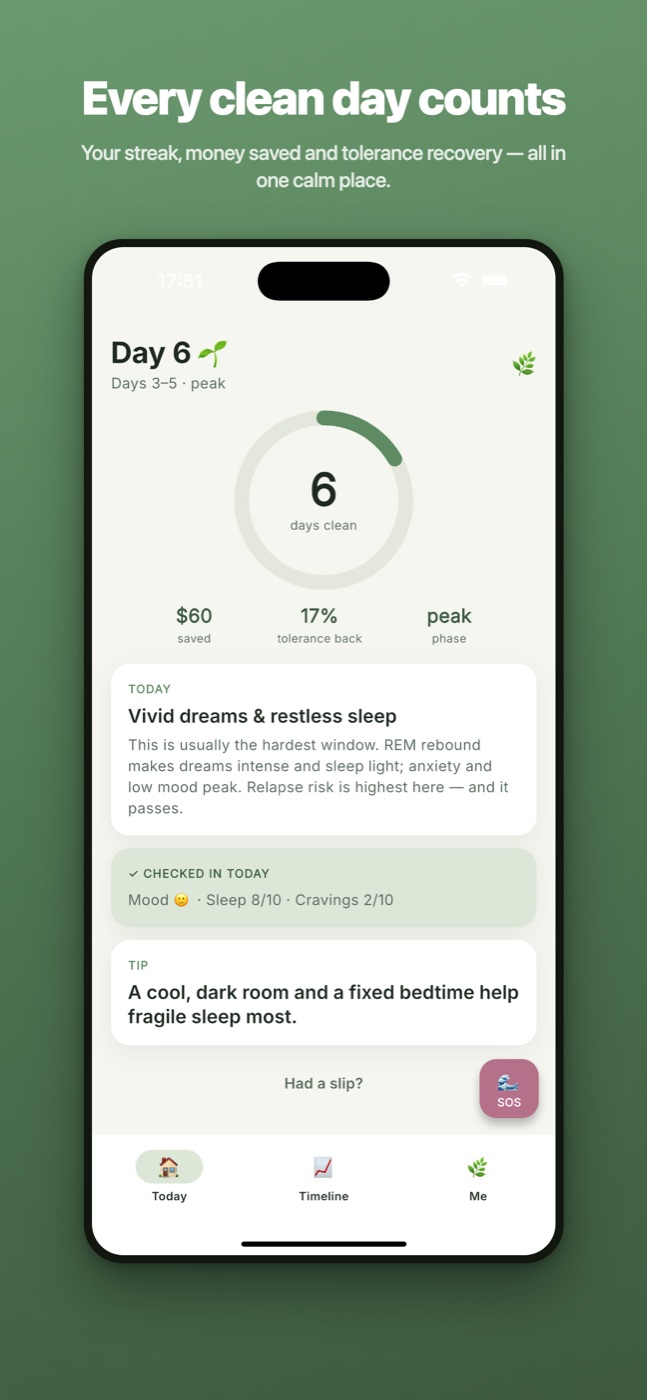
You pick a goal (quit, tolerance break or cut back) and tell the app when you last used. The count starts then, not when you installed it. It counts in hours for the first 72 hours, then in days.
Every day has a plain-language "what to expect" and one practical tip. The daily check-in asks you to rate mood, sleep, cravings, dreams and anxiety, then shows how your day compares with a typical day at the same point for someone like you. A rough day 4 is often right on schedule.
For bad moments there is Craving SOS: your own reasons in your own words, guided 4-2-6 breathing and a 10-minute urge-surf timer. If you slip, you log it and the count restarts. Your history and longest streak stay saved.
The withdrawal timeline in the app
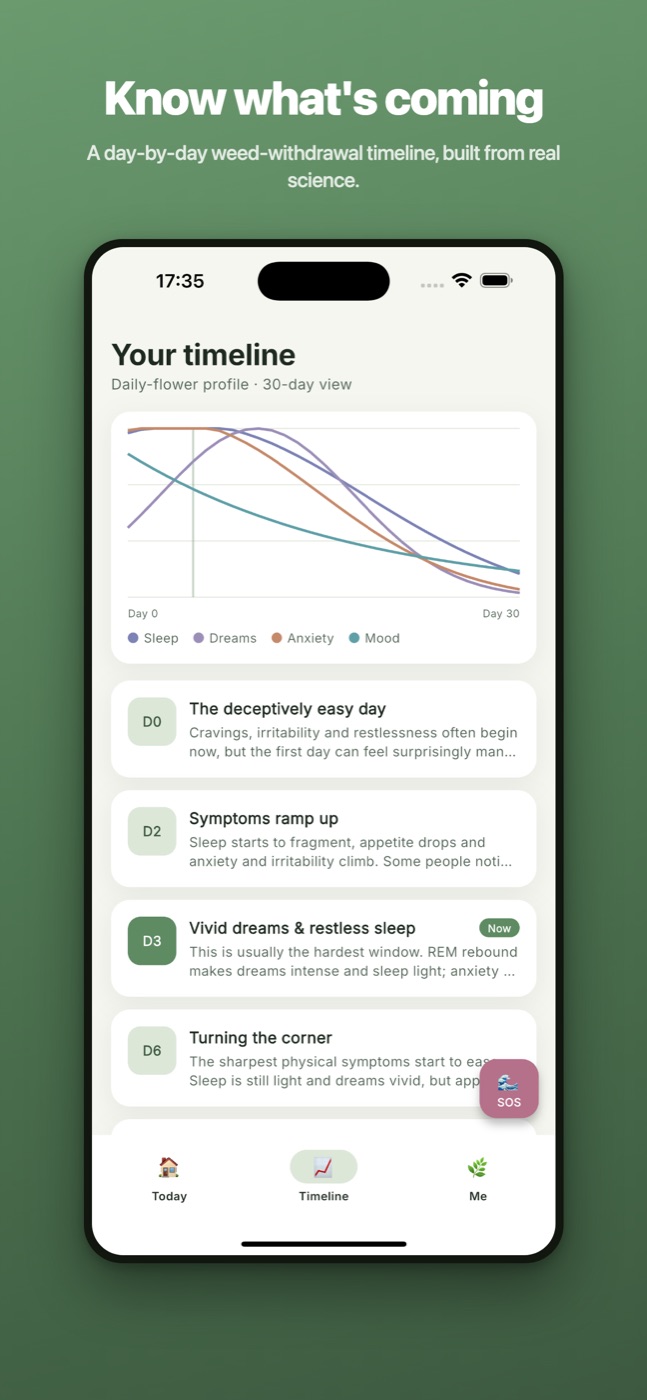
The timeline is the part I spent the most time on. It draws six tracks (sleep, vivid dreams, appetite, mood, anxiety and cravings) across your first weeks, based on published research, with the sources listed in the app. It is tuned to how you used: how often, and whether it was flower, vape/concentrate or edibles. In the current build a moderate-use profile covers 21 days, a daily-flower profile 30 and a concentrate-heavy profile 38.
The day cards follow those ranges:
- Day 1: often easier than expected, though cravings and irritability can start.
- Days 2–3: sleep fragments, appetite drops, anxiety climbs.
- Days 3–5: usually the hardest window, with vivid dreams and light sleep.
- Weeks 1–2: the sharpest symptoms ease; dreams often peak, then fade.
- Weeks 3–4: for most people mood evens out, and sleep and appetite come back.
- Day 30 on: heavy, long-term users may still notice symptoms now and then.
It is a typical curve, not a prediction. If your day 5 beats the chart, good.
Milestones and money saved
A countdown runs to the next milestone: 24 hours, 72 hours, a week, 30 days and on. Since version 1.3.0 (3 November 2026) milestones up to a year earn badges, as do urges ridden out, check-ins and coming back after a slip. Slips never take a badge away.
Money not spent is shown in your own currency, based on what you say you usually spend a day. Every Monday a short recap compares last week with the week before, and the check-in streak allows one missed day a week.
What happens to your data
I'd rather be exact here than impressive. Per the privacy policy and the listing:
- No account or email to start. The app uses an anonymous identifier.
- It stores your goal, usage profile (frequency, form, years, spend), start date and daily check-ins.
- Data is saved on your phone first, so the app works offline, then synced in the background to my backend on Supabase over HTTPS, where each user can only access their own rows. Private, but not on-device only.
- No ads, no third-party tracking SDKs, nothing sold.
- You can export your data, and delete everything from inside the app, on the phone and on the server.
- Reminders and the home-screen widget never mention weed, cannabis or THC.
Quitting or a tolerance break
Both are legitimate goals. Tolerance is linked to regular use desensitising and reducing the brain's CB1 cannabinoid receptors. That starts to reverse within the first two days without cannabis, and the receptors return to normal after roughly four weeks (Bonnet and Preuss).
T-break mode gives you a 48-hour, 7-day or 21-day countdown and a ring that estimates your tolerance recovering on that model. It is an illustration, not a measurement. A 48-hour break ends about where withdrawal, if you get it, usually starts to peak. Afterwards you can extend it, and a short harm-reduction guide explains why your tolerance is likely lower and how to stay safe.
Not ready for either? Cut-back mode sets a weekly goal and logs sessions in two taps, with no days-clean counter.
Who it's for, and who it isn't
Reset is for adults (18+) who want to stop or pause and know what's coming. The app is available in English, Spanish, Portuguese (Brazil), German and Russian.
It is education, not medical advice, and not a treatment for cannabis use disorder. Talk to a doctor if you've used heavily every day for a long time, use other substances, have mental-health concerns, or if withdrawal feels severe. The first-line help is supportive counselling and psychoeducation; no medication is approved specifically for it (Connor et al.). Talking to someone is the real treatment, not a fallback. In the US, SAMHSA's National Helpline is 1-800-662-4357: free, confidential, 24/7, for treatment referral and information. In a crisis, call or text 988.
How to get started
- Download Reset from the App Store. It needs iOS 15 or later and also runs on iPad.
- Choose quit, tolerance break or cut back.
- Enter when you last used, how often, and in what form.
- Start the two-week free trial on the yearly plan, or subscribe monthly. The trial's end date and the price after it are shown before you start, and you get a reminder two days before it ends.
- Add your usual daily spend if you want the money counter.
- Write your reasons into Craving SOS while you still feel sure of them.
- Check in once a day.
FAQ
How long does weed withdrawal last?
For people who get it, cannabis withdrawal usually starts 24 to 48 hours after the last use, peaks between days 2 and 6, and lasts up to about three weeks (Connor et al., 2022; Bonnet and Preuss, 2017). Heavy users can have some symptoms for three weeks or more, and sleep problems may last several weeks.
What should I expect when I stop smoking weed?
The most common withdrawal symptoms are anxiety, irritability, anger, trouble sleeping, strange dreams, low mood and loss of appetite; some people also get restlessness, headaches, sweating, stomach pain or tremor (NIDA).
Is there an app to help me quit weed or take a T-break?
Reset is an iPhone app for quitting weed or taking a tolerance break, with 48-hour, 7-day and 21-day T-break countdowns, a day-by-day withdrawal timeline tuned to how you used, check-ins, milestones and money saved. It is on the App Store.
How long should a tolerance break be?
There is no single right length. The CB1 receptor changes behind tolerance start to reverse within two days of stopping and return to normal after roughly four weeks (Bonnet and Preuss, 2017), so a longer break gives them more time.
Why am I having vivid dreams after quitting weed?
Disturbed sleep and strange or vivid dreams are among the most common cannabis withdrawal symptoms, and the dreams often start later than the rest (Bonnet and Preuss, 2017). Sleep problems may continue for several weeks or longer (Connor et al., 2022).
Is weed withdrawal dangerous, and when should I see a doctor?
Cannabis withdrawal doesn't carry a high risk of severe outcomes, but it is harder with mental-health conditions or other substance use (Connor et al., 2022). See a doctor if symptoms feel severe, you use other substances, or you have mental-health concerns. In the US, SAMHSA's National Helpline, 1-800-662-4357, is free, confidential and open 24/7.
Is Reset free, and does it need an account?
Reset is free to download and needs a subscription after a two-week free trial on the yearly plan: $29.99 a year or $3.99 a month on the US App Store at the time of writing. Craving SOS always opens without a subscription, so nobody hits a paywall in a hard moment. No account or email is needed: data is saved on your phone, synced in the background under an anonymous identifier, and never sold.
More writing
Aquarium water test log apps for iPhone: 8 compared
Eight iPhone apps for logging aquarium water tests compared: freshwater or reef, test strip scanning, species database, account, and what each costs.
Free parking in Madrid, Barcelona and Valencia: 7 apps compared
Most Spanish parking apps help you pay, not park free. Seven apps compared for Madrid, Barcelona and Valencia, and which one maps free street parking.
Pet health record apps for iPhone: 7 compared
Seven iPhone apps for your pet's vaccinations, vet visits and documents compared: which work without your vet joining, store your own scans, and cost.